Factory · Quality Control
One QC chain, from yarn lot to sealed carton
Quality is not an inspection at the end. It is a chain of decisions: which yarn lot, which machine, which check at which station, and what happens when something is wrong. Here is ours, end to end.
The QC numbers we hold ourselves to
What we test, and to which standard
In-house lab testing on every programme. Third-party testing available on request, with certificates issued against the test report.
| Test | Standard | Requirement |
|---|---|---|
| Colourfastness to washing | ISO 105-X12 / AATCC 61 | Grade 4+ |
| Colourfastness to rubbing | ISO 105-X16 | Grade 4 dry, 3–4 wet |
| Dimensional stability | ISO 5077 / AATCC 135 | ±3% after five washes |
| Pilling resistance | ISO 12945-2 | Grade 4+ |
| Compression pressure | RAL-GZ 387 | ±10% of stated mmHg class |
| Harmful substances | OEKO-TEX® Standard 100 | Class I (baby) and Class II (skin contact) |
| Colour match | Spectrophotometer | ±0.8 ΔE against the approved standard |
| Waistband recovery (underwear) | In-house protocol | Recovery within 5% after 20 cycles |
| Shrinkage (underwear) | ISO 5077 | Under 4% after five washes |
Where the checks happen
Four inline stations, then a final inspection
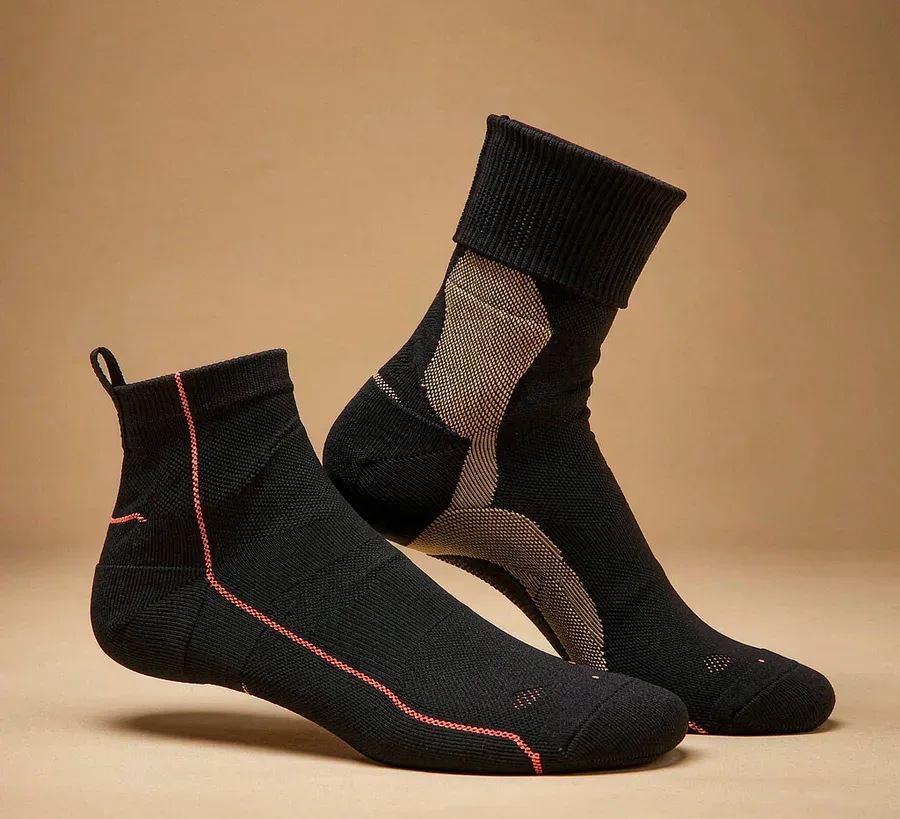
An inline check catches a fault while it is still one pair of socks. A final inspection catches it after it is 5,000. We do both, because the earlier a fault is caught, the cheaper it is to fix and the less of your schedule it consumes.
- Yarn lot inspection — count consistency and dye lot match on arrival, before a machine is set
- Station 1 · knitting — pattern, gauge and colour checked against the approved standard
- Station 2 · linking — toe seam integrity and hand-linked toe quality
- Station 3 · boarding — size, shape and silhouette against the approved sample
- Station 4 · pairing — pairing accuracy, size marking and packing correctness
- Final inspection — AQL 2.5 to the agreed defect classification, with a photographic report on every shipment
How quality problems are actually handled
Defects are classified, not argued about
Critical, major and minor defects are defined in the specification you approve, so an inspection outcome is a calculation rather than an opinion.
A photo report on every shipment
The inspection report ships with photographs, so you can see what we saw. Third-party inspection is welcome as a second opinion.
Two independent checks
The mill runs its own inline checks and we run ours, plus the final AQL inspection. Two sets of eyes on the same order is deliberate.
What happens when something is wrong
Where a claim is verified, our liability is replacement of the affected goods free of charge, or a credit note at the invoiced unit price. Visible defects must be raised before dispatch; latent defects within 30 days of receipt.
Frequently asked questions
How do you control quality?
One accountable QC chain from yarn to carton: yarn lot inspection on arrival, inline checks at knitting, linking, boarding and pairing, then AQL 2.5 final inspection with a photo report on every shipment. Our lab tests colourfastness (ISO 105), dimensional stability (±3% after five washes), pilling (ISO 12945-2) and mmHg pressure for compression styles.
What is AQL 2.5 and does it mean anything?
AQL 2.5 is an accepted sampling standard: for a given lot size, it sets how many units must be inspected and how many defects are permitted before the lot is rejected. It is meaningful only if the defect definitions are agreed in advance — which is why critical, major and minor defects are written into the specification you approve.
Can we audit the production site?
Yes. Third-party inspections (SGS, Intertek, Bureau Veritas), a pre-shipment site visit, or a live video walkthrough of the line running your order — all available. We also share the audit criteria we apply to every partner mill.
Can I use my own inspection company?
Yes. SGS, Intertek, Bureau Veritas or your own appointed inspector are all welcome before shipment, and we will schedule production so the inspection can happen without delaying the dispatch date.
What happens if I find a defect after the goods arrive?
Raise it with photographs within 30 days of receipt. Where the claim is verified, we replace the affected goods free of charge or issue a credit note at the invoiced unit price. Where the cause is a mismatch between the goods and the approved sample, that is straightforwardly our responsibility.
Do you test every batch of compression socks?
Yes. Compression is the one category where the product claim is measurable, so every batch is pressure tested to RAL-GZ 387 and the report ships with the goods. That report is what supports the mmHg claim on your packaging.
Which certifications apply to your production?
OEKO-TEX® Standard 100, ISO 9001:2015, BSCI, SMETA 4-Pillar. Materials include GOTS organic cotton · RWS merino wool · GRS recycled polyester · bamboo, modal, combed and mercerized cotton · wicking polyamide blends. Certificates are shared on request, and third-party audits by SGS, Intertek or Bureau Veritas are welcome before shipment.
Ask to see the QC documentation.
Request a sample inspection report, the defect classification sheet, or a live walkthrough of the line running your order.