Factory · Capacity
Capacity, planned against your delivery window
We do not publish a headline pairs-per-year number, because a number like that tells a buyer nothing about whether their order will ship on time. What matters is whether capacity is booked against your date — so that is what we describe here.
Lead times by construction
Typical lead time by product
From deposit and sample approval. Shipping transit is quoted separately and as a range.
| Product | Sampling | Bulk production | Why |
|---|---|---|---|
| Sublimation printed socks | 5–7 days | 15–20 days | No knit pattern round needed |
| Combed cotton everyday crew | 5 days | 25–30 days | Volume run, longer machine time |
| Knitted logo crew | 7–10 days | 18–25 days | Pattern development plus knitting |
| Cushioned performance / terry | 7 days | 20–25 days | Heavier yarn, slower machine speed |
| Merino wool hiking | 10 days | 25–30 days | Yarn lead time plus slower knitting |
| Graduated compression | 10 days | 25–30 days | Pressure testing per batch |
| Thermal fleece-lined | 7 days | 20–28 days | Fleece lining and cable knitting |
| Underwear (cut and sew) | 10–14 days | 20–28 days | Pattern and fit validation first |
| Underwear (seamless) | 10–14 days | 25–32 days | Circular-knit machinery, longer runs |
How capacity is booked
Capacity is reserved against your date, not queued behind whatever is running
When you accept a quotation with a delivery window, line time is booked against that window. That is the practical difference between a supplier who can plan and one who cannot: your order is in the schedule before your deposit clears, not after.
- Slot booked at order confirmation — your dates are in the production plan from the start
- Yarn allocated to the programme — on volume orders, so dye lots stay consistent
- Dated production plan issued to you — you can see the milestones, not just the end date
- Weekly written reporting — a photo and video record with the current stage and the next milestone
- Early warning — if a date is at risk you hear it from us the week it becomes apparent
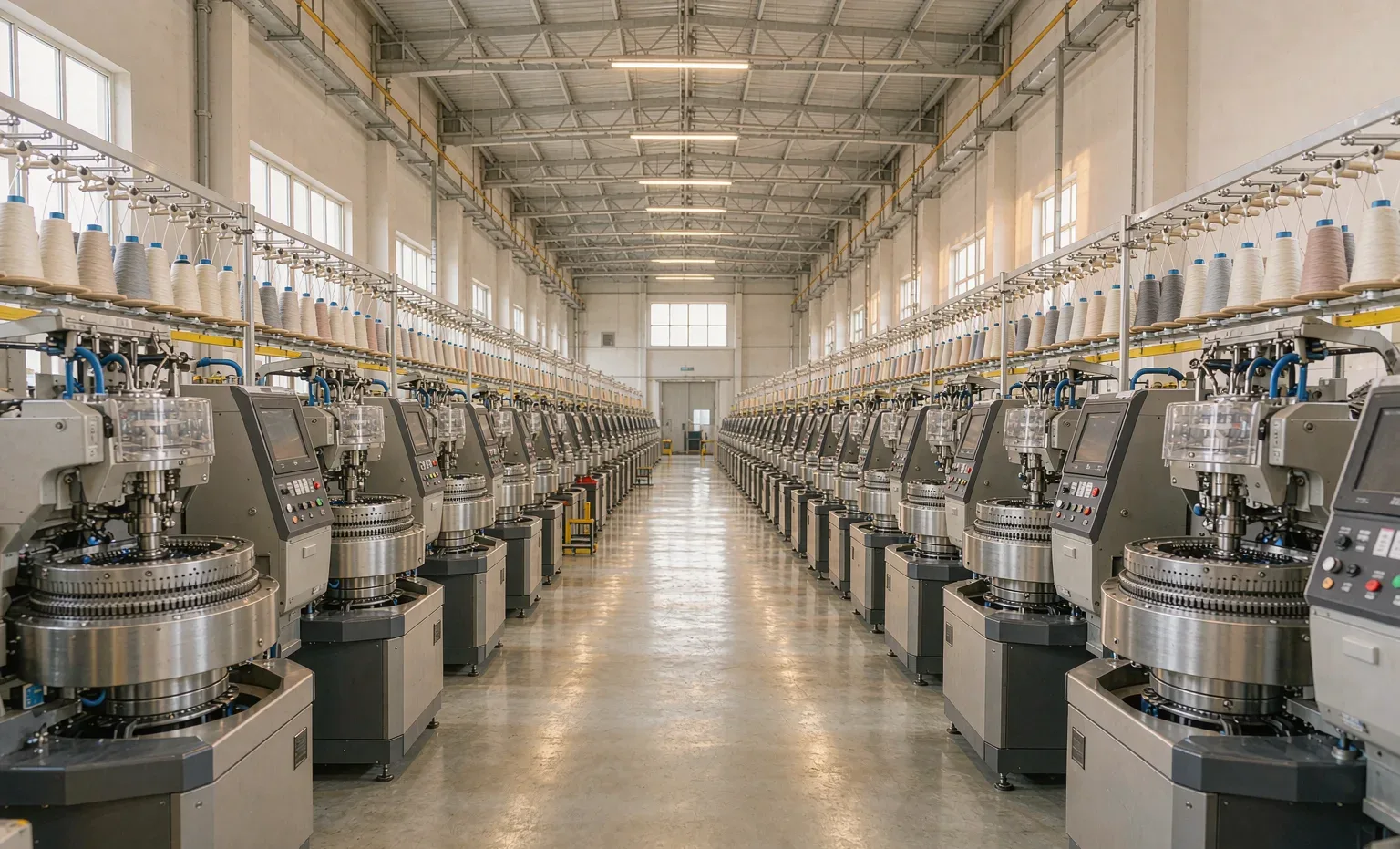
How we talk about time
Lead times quoted as ranges, not dates
A single date implies precision the supply chain does not have. A range with buffer built in is more useful, and it is the honest way to quote.
The bottleneck is named up front
On compression styles it is pressure testing. On merino it is yarn lead time. On seamless underwear it is machine availability. We tell you which constraint applies to your product before you commit.
Weekly reporting during the run
A written report with photographs every week your order is in production, so a problem surfaces while it is still cheap to fix.
Buffer built into the promise
We would rather quote a range we can beat than a date we might miss. If your window is genuinely tight we will say so at quotation stage.
Frequently asked questions
What is the bulk production lead time?
18–28 days from deposit and sample approval. Compression and heavy terry constructions sit at the longer end. You receive a photo and video progress report every week while your order runs.
What is your annual production capacity?
We deliberately do not publish a headline capacity figure. A pairs-per-year number is a marketing statistic, not a planning fact — it says nothing about whether your order will be in the schedule on your date. What we will tell you is whether the specific capacity your product needs is available in your specific window.
Can you hit a tight deadline?
Sometimes, and we will tell you honestly. Sublimation-printed styles are the fastest because they skip the knit pattern round. Express production is occasionally possible on repeat orders where the specification is already locked. Tell us the date first and we will answer before we quote.
What causes delays most often?
In order of frequency: a specification change after sample approval, artwork or label copy arriving late, packaging approval arriving after production has started, and yarn lead time on certified or specialist yarns. Almost all of it is input timing rather than production.
What payment terms do you accept?
30% T/T deposit, balance against B/L copy · L/C at sight above USD 30,000. First orders from new markets may need a higher deposit — we stay flexible for verified buyers and repeat programs.
How do you control quality?
One accountable QC chain from yarn to carton: yarn lot inspection on arrival, inline checks at knitting, linking, boarding and pairing, then AQL 2.5 final inspection with a photo report on every shipment. Our lab tests colourfastness (ISO 105), dimensional stability (±3% after five washes), pilling (ISO 12945-2) and mmHg pressure for compression styles.
Tell us your delivery window.
We will confirm whether the capacity your product needs is available, before you commit to anything.